
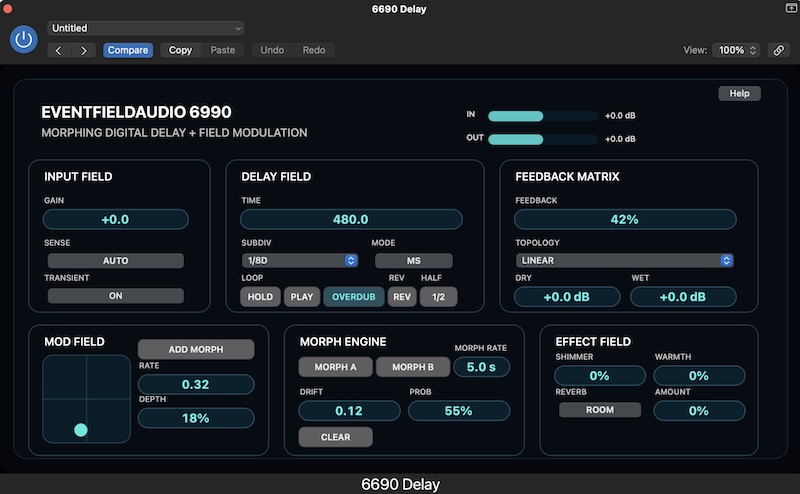
6990 Delay is an in-development delay processor, focused on musical timing, space and repeatable control for producers.
Platform: macOS
Availability: Information coming soon
Producer-Oriented Delay Workflow
Designed for fast, practical decisions in real sessions.
Clear Timing and Rhythmic Control
Built for both groove-driven delay structures and broader textural use.
Practical Sound-Shaping
Aimed at composition and mix workflows rather than unnecessary complexity.
Repeatable Results
Control architecture designed to support reliable, recallable outcomes.
Technical Overview
6990 Delay is being developed as a structured delay processor for producers who need precision, repeatability and musical flexibility in one tool. The focus is not on maximum parameter count, but on a clear control architecture where each adjustment has a direct audible result and predictable interaction with the rest of the system. It is intended to support both composition and mixing, with a signal path that stays understandable even in more complex settings.
At a high level, 6990 Delay is organised around a deterministic timing core, a controllable feedback network and a post-delay shaping stage. The timing core defines the temporal grid and interpolation behaviour. The feedback network determines how repeats accumulate, disperse or lock into rhythmic structures. The shaping stage manages tonal contour and spatial placement so repeats can sit in an arrangement without masking key material. This layered model treats delay as compositional structure, not only an effect send.
Timing Engine and Synchronisation
The timing engine is designed to run in two modes: host-synchronised time and absolute time. In synchronised operation, delay times are quantised to musical divisions relative to session tempo, allowing repeat patterns that remain phase coherent under transport movement and tempo changes. In absolute mode, delay times are set in milliseconds for sound design and micro-timing work where strict grid alignment is not required.
Special attention is given to transitions between delay times. Abrupt changes can cause discontinuities, pitch artefacts or transients depending on buffer state and interpolation method. 6990 Delay is designed to handle these transitions in a controlled way so modulation remains useful in production contexts.
Feedback Topology and Stability
The feedback section is being developed with stability and musical control as first priorities. Feedback behaviour can become unpredictable when gain staging, filtering and modulation interact non-linearly, especially at high regeneration settings. 6990 Delay is structured so feedback response remains readable across practical ranges, allowing higher density and sustain without immediate collapse into unusable states.
Rather than treating feedback as a single scalar control, the design supports a clear relationship between repeat persistence, spectral evolution and rhythmic clarity. This allows short controlled repeat trains for groove reinforcement, or longer evolving tails for texture and movement, with behaviour that can be recalled reliably.
Spectral and Dynamic Shaping
Delay repeats often compete with source material in similar spectral and temporal regions. 6990 Delay includes shaping controls aimed at placing repeats in the mix with minimal friction. The direction is practical filtering and tone management that can quickly move repeats away from vocal, transient or low-frequency anchors while keeping depth and detail.
Dynamic behaviour is treated as part of repeat design, not as a separate afterthought. As repeats build, spectral weighting and level behaviour can be adjusted to reduce masking and maintain intelligibility.
Spatial Behaviour
Spatial handling is being developed to preserve mono compatibility while still allowing useful width and depth control. Stereo behaviour is treated as a deliberate layer, not an accidental by-product of modulation. This allows repeats to be placed with intent: centred for structural support, widened for atmosphere, or distributed asymmetrically for movement.
Modulation and Motion
Modulation can add life and analogue character, but it can also blur rhythmic intent if overused. 6990 Delay is being built with modulation pathways that preserve timing clarity and control resolution. The aim is musical movement with repeatable results.
From a workflow perspective, controls are designed to map to audible outcomes in a producer-friendly way: subtle drift where needed, stronger animation where required and clear limits for reliable recall.
Performance and Recall
Performance targets prioritise low overhead and predictable runtime behaviour. Delay processors are often instantiated multiple times across sends and inserts, so efficiency is treated as a core requirement. Latency behaviour is considered explicitly so operation remains coherent with host compensation.
Parameter semantics are designed to be descriptive and automation ready. Control groupings and names map to functional roles in the processing path, with minimal hidden coupling. Preset and state recall are part of the architecture from the beginning, including deterministic initialisation and stable reconstruction of time dependent states.