EventFieldAudio / Phasing instrument + drift field / Free, runs in your browser
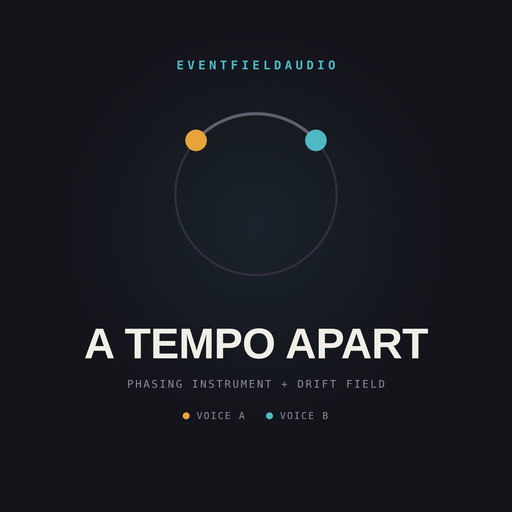
Two voices read the same source. One of them runs slightly faster. That is the whole idea.
Everything else that happens comes out of that one decision. The voices start locked together. The faster one edges ahead, a millisecond at a time, until what was a single sound becomes two. It thickens, it smears, it turns into a rhythm that nobody wrote. Then it keeps going and finds its way back to where it started.
Where it came from
This idea is older than I am. In the 1960s people were doing it with two tape machines and two copies of the same loop, and it worked because no two machines ever run at exactly the same speed. The drift was a fault in the equipment. Somebody noticed the fault was more interesting than the loop.
What always got me about that approach is that the composer sets the process running and then stops composing. You choose the source and you choose the rate, and after that the piece writes itself in real time. You are not making decisions any more. You are listening to the consequences of one decision you already made.
I wanted to hear that with my own material rather than read about it, so I built the tool.
What it does
Two voices, hard panned. Voice A left, Voice B right, both playing the same thing. The drift is spatial as well as rhythmic, so you hear the gap open up across the stereo field.
Your own audio. Load any file and both voices loop it, one slightly faster. Stereo gets folded down to mono first, and you choose how: sum, left, right, or the difference signal. There is a correlation meter so you can see whether summing is going to hollow your file out before you hear it happen. You can download the mono bounce and use it elsewhere.
A drift field. The rate of drift can itself be modulated. Sweep it from one value to another over anything from five seconds to fifteen minutes, sine or triangle. Cross zero and Voice B falls behind, stops dead against Voice A, then overtakes. Those crossings are the moments where the two lock for a second before pulling apart the other way.
Or build a pattern. If you have no file to hand there is a step sequencer with three sounds, so you can hear the principle working in about ten seconds.
Export. Renders offline at 48kHz stereo, faster than real time, up to twenty minutes. It comes out as a WAV that drops straight into a session.
What it is good for
Drum loops that need to stop sounding like a grid. A vocal phrase that you want to turn into a texture without a reverb. A guitar figure that should feel like it is coming apart. Anything where you want a result that you could not have programmed, because the process found it rather than you.
I have been using it to generate source material for a record. Load something, set a slow drift, render fifteen minutes, then go hunting through the file for the ninety seconds where it did something I would never have thought of. It is really fantastic for making mono synths stereo with movement, in a way that just isn’t typically heard.
Launch the App