
EventFieldAudio
First
Passage
A first-passage composition environment
A browser-based composition tool in which multiple voices read the same source material, but reach it by different routes and at different times.
One source
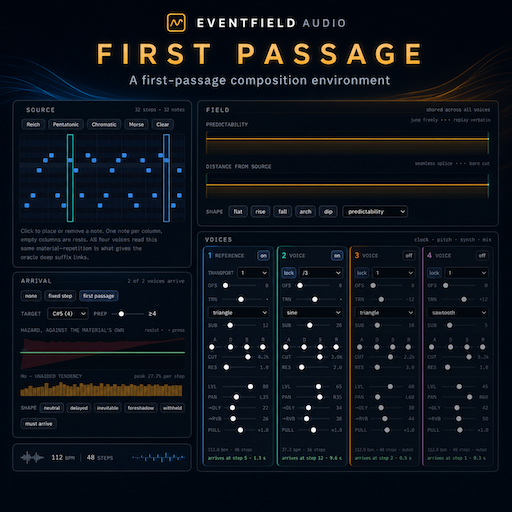
Draw a short note pattern once. All active voices read the same material, so repetition becomes the basis of relationship rather than simple duplication.
A shaped field
Shared curves control predictability and distance from the source over piece time, determining how freely each voice jumps, returns or replays.
Arrival as form
Voices can be asked to arrive at a target by first passage, turning timing, tendency and threshold into part of the composition itself.
What First Passage does
First Passage begins with a simple source pattern. You place notes on a grid, leave gaps as rests and create the material that every voice will read.
The important part is that the voices do not simply play that material back verbatim. A shared field controls how predictable they are and how far they may move from the source. As the field changes over time, the relationship between repetition and deviation changes with it.
Each voice then has its own transport, pitch offset and synthesis settings, so a single source can unfold as a family of related lines rather than as a single sequence copied several times.
The field
The field is shared across all voices. It shapes two broad behaviours: how predictable the output is and how distant it may move from the source material.
Different curve shapes let that relationship remain flat, rise, fall, arch or dip across the duration of the piece. This means the system can begin by closely replaying the source, gradually move away from it or return to it later.
In practical terms, the field is where you decide whether the piece should remember clearly, wander cautiously or drift into looser reinterpretation.
Arrival and first passage
Arrival is where First Passage becomes more than a variation engine. Instead of only asking what a voice should play, the instrument also asks when a voice first reaches a chosen target.
The arrival controls let you define a target, shape the pressure towards it and decide whether arrival should be absent, fixed or governed by first-passage behaviour. The result is that expectation and threshold become compositional material.
A voice can therefore feel as though it is resisting, approaching, foreshadowing or inevitably reaching something, even when all voices are still reading the same underlying source.
Voices and sound
Up to four voices can be active. Each has its own clock relationship, transposition, waveform and mix settings, allowing the same source to be heard at different rates, in different registers and with different sonic roles.
This makes First Passage as much an instrument as a sequencing system. The source, the field and the arrival logic define the behaviour, while the individual voice settings turn that behaviour into texture, counterpoint and structure.
What it does not do
First Passage is not an AI songwriter, and it is not designed to replace composition with automatic output. It does not generate finished songs at the press of a button.
It is also not a conventional step sequencer in which every event is fixed in advance. The point is not simply to store notes, but to explore how one source can produce several related futures under changing conditions.
Its purpose is to create a playable environment for repetition, deviation, threshold and arrival.
Areas of investigation
Questions explored by the instrument
How much can repetition contain?
What kinds of complexity and relationship can emerge when every voice begins from the same small source?
When does variation become form?
Can a shared field turn local deviations into larger arcs of tension, drift, return and recognition?
What does arrival sound like?
How can pressure towards a first arrival become audible as expectation, resistance, inevitability or release?
Can timing carry meaning?
What happens when a note is first reached matters as much as which note is reached?
Shared material, separate identities
How far can voices separate in rate, register and timbre while still feeling like manifestations of the same source?
Composer as field designer
What changes when the composer writes conditions, tendencies and thresholds instead of determining every event directly?