
EventFieldAudio
Common
Origin
Two probabilistic futures from one musical point
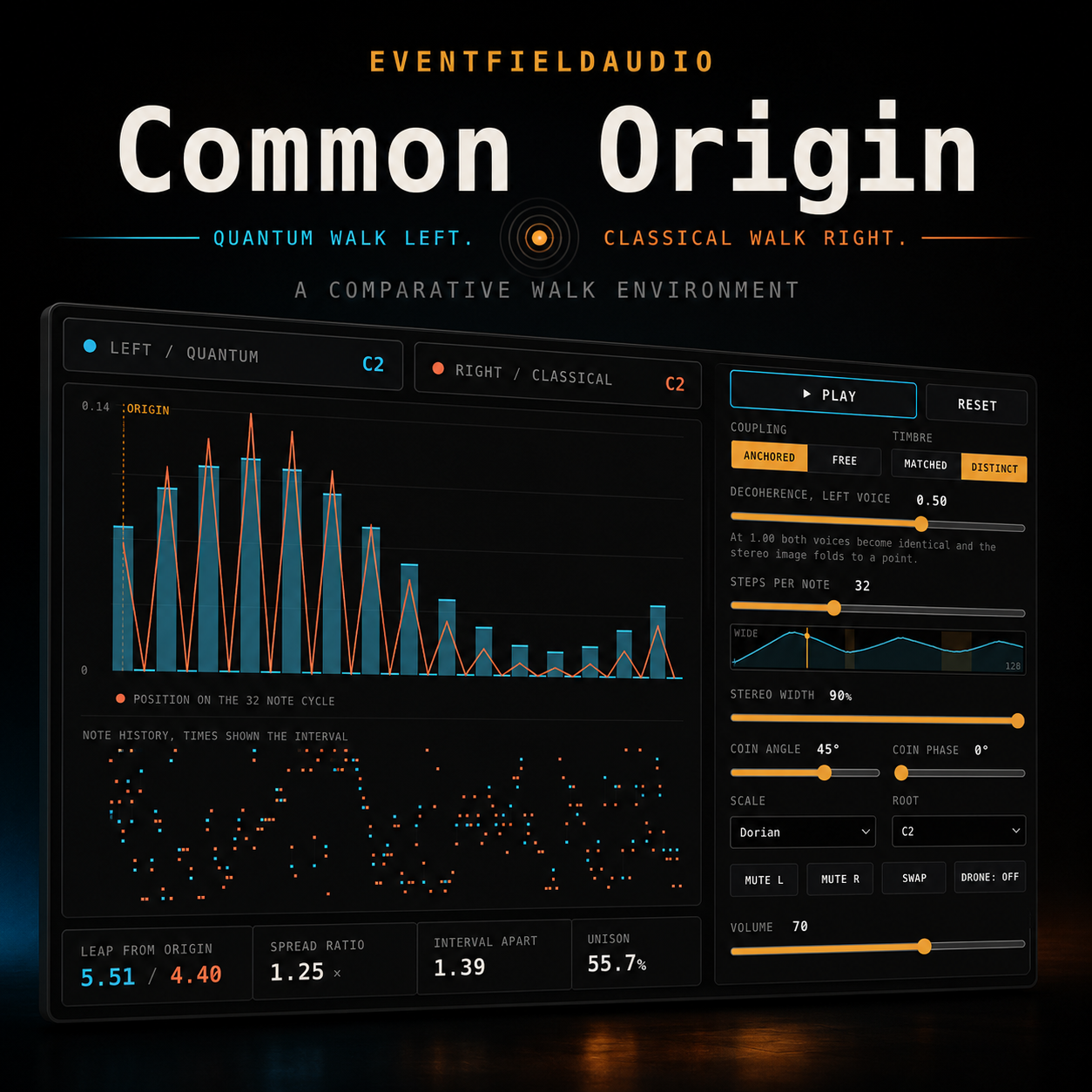
A browser-based musical instrument that places a simulated quantum walk in the left speaker and a classical random walk in the right.
Same beginning
Both voices begin from the same pitch and evolve for the same number of internal steps.
Different rules
The classical walk spreads diffusively. The coherent quantum walk spreads through amplitudes, phase and interference.
Audible distance
The interval between the selected notes turns a difference between the two probability models into harmony and stereo movement.
What Common Origin does
Both processes begin from a shared origin. Each evolves for the same number of internal steps, produces a probability distribution and selects a note using a shared sampling value.
At shorter evolution times, both distributions remain concentrated near the origin, so smaller intervals are more common. As the number of steps increases, the quantum distribution will generally extend further than the corresponding classical distribution. Wider intervals therefore become more likely.
This is a statistical tendency rather than a rule for every note. The step control becomes a way of shaping harmonic width, register and musical distance rather than simply increasing randomness.
Decoherence
At the coherent quantum end of the control, phase relationships are preserved. Interference reinforces some possible outcomes and suppresses others, allowing the quantum voice to diverge from its classical counterpart.
As decoherence increases, those phase relationships are progressively disrupted. Interference is reduced and the simulated quantum process moves towards the classical behaviour defined by the instrument.
At the fully classical endpoint, both systems produce the same probability distribution. Because Common Origin uses the same sampling value for both, the voices select the same note and perceptually meet in the centre. This is a change in the note-generating process, not an audio crossfade or panning effect.
A musical comparison
An early version allowed both voices to evolve freely. They lost their shared reference point almost immediately and the intervals between them became broadly unpredictable. The mathematical comparison remained valid, but the musical relationship became difficult to hear.
Common Origin therefore returns both systems to a common point before each event. The classical voice becomes a probabilistic shadow of the quantum voice. The notes can separate, but they always separate from a shared origin.
This anchored design turns an abstract comparison into a bounded and playable musical relationship.
What it does not do
Common Origin does not use quantum computing hardware. It simulates a quantum walk and a classical random walk in an ordinary web browser.
It does not claim that every audible difference is uniquely quantum. Scale, pitch mapping, measurement interval, rhythm, stereo arrangement, sampling and synthesis all shape the result. It is one designed sonification of the difference between the models, not a complete auditory representation of quantum mechanics.
It is not an autonomous composition system and does not automatically create motifs, songs or large-scale form. The anchored classical voice is also not intended as independent counterpoint. The instrument is designed to generate, compare and examine musical behaviour.
Areas of investigation
Questions explored by the instrument
Can the difference be heard?
Which properties of the two processes remain perceptible as contour, register, spacing, density and movement?
Measurement as composition
How long should the state evolve before possibility becomes a note, and where does distinction become disconnection?
Interference as constraint
Can outcomes reinforced or suppressed by accumulated phase become musically useful rather than merely mathematically interesting?
Harmony through divergence
Can evolution time, interference and decoherence act as meaningful controls over harmony, register and spacing?
Agreement as an event
Can convergence be heard as stability, arrival, confirmation or collapse rather than simply the absence of difference?
Agency and authorship
What happens when the composer writes the conditions under which notes emerge rather than specifying every note?