
Note: External MIDI requires a local script to be run. The script and instructions are available here.
Use of this script is at your own risk. Mac only.
EventFieldAudio
ERRANT
Generative rhythm, unstable melody and microtonal drift
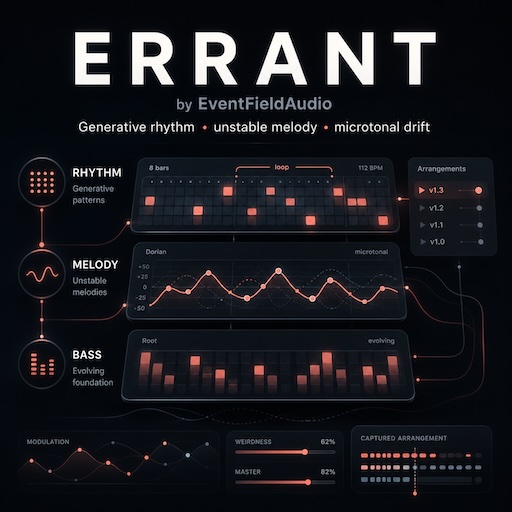
A browser-based instrument for generating, editing and performing rhythm, melody and bass as three interacting systems, then capturing the versions worth keeping as a longer MIDI arrangement.
Three independent engines
Rhythm, melody and bass can each run from one to sixteen bars, creating slowly changing relationships rather than a single fixed loop.
Generate, edit, recall
Every generated version remains available. Recall it when stopped or queue it to change cleanly at the end of its own sequence.
Capture as arrangement
Keep selected ideas, build a longer form and export individual loops, combined scenes or the complete captured arrangement as MIDI.
What Errant does
Errant generates rhythm, melody and bass as related but independently moving systems. Each engine has its own loop length, pattern history, internal sound, MIDI routing and capture lane.
The instrument is designed around productive instability. A pattern can remain recognisable while density, displacement, memory error, microtonal drift and polymetric repetition continually expose different relationships inside it.
Generation is only the beginning. Notes and drum steps remain editable, versions can be recalled and chosen material can be captured into a longer arrangement.
Rhythm engine
The rhythm engine creates four editable voices: kick, snare, hat and circuit percussion. It combines Euclidean skeletons with optional live layers for density, displacement, ratchets and swing.
Those layers can be switched on independently. With them off, the rhythm plays exactly as drawn. Protected quarter-note kick downbeats remain stable when density or displacement is active, while ratchets are exported as real repeated MIDI notes.
Sixteen internal kits range from punch-focused club and breakbeat sounds to brittle, metallic and deliberately damaged percussion.
Melody, memory and microtonality
The melody engine begins with an identity of one to sixteen notes. It reconstructs that identity across the loop, allowing later returns to swap, forget or replace parts of the phrase without losing its underlying character.
Major modes, melodic minor modes, harmonic minor modes and a broad group of exotic and symmetrical scales are available. Scale and tuning remain separate, so the same modal identity can be heard in Equal Temperament, 19, 22, 24, 31 or 53 divisions, Just Intonation, Pythagorean tuning, a custom cents table or an imported Scala file.
The piano roll supports pitch dragging, visible velocity editing and per-note cent offsets. Any audio file can also be analysed as control data, using its pitch contour and onset energy to influence the generated line.
Bass and interaction
The bass engine occupies its own editable low-register piano roll. It can lock to the kick, dodge the kick, follow the melody or run as an independent Euclidean cycle.
Because bass, rhythm and melody may use different loop lengths, a simple foundation can continually meet the other parts in new places without losing its own identity.
Performance, sound and effects
Errant includes internal drum, melody and bass sounds, ADSR envelopes, a compact stereo mixer and per-instrument delay and reverb sends. Melody also has its own chorus.
The global delay offers straight, dotted and triplet divisions from 1/1 to 1/16, filtering, stereo spread and ping-pong feedback. Reverb types include plate, room, hall, ambience and nonlinear, with size, decay, pre-delay, diffusion and tone controls.
The Meta Modulator provides an X/Y pad and a separate Z axis. Three performance-safe controls can be assigned manually or at random and performed together from one overlay.
Versions, capture and MIDI
Every generated rhythm, melody and bass version appears as a numbered button. During playback, selecting a version queues the change until that engine reaches the end of its own loop, preventing mid-phrase jumps.
Internal sound and one or more external MIDI destinations can operate at the same time. Errant supports hardware MIDI, software instruments and the macOS IAC bus when launched through the included localhost launcher.
MIDI files may contain the current loop, a combined scene or the complete captured arrangement. Microtonal lines use pitch bend and optional MPE-style channel allocation.
What Errant is investigating
Questions inside the instrument
How stable must an identity remain?
How much can a phrase forget, drift or mutate before it stops being recognisable?
Can repetition keep changing?
What happens when several finite loops repeat independently and their larger relationship is never heard the same way twice?
Where does authorship sit?
The musician designs the conditions, edits the results, performs the system and chooses what becomes form.
Can error become expression?
Displacement, memory error and tuning instability are treated as controllable musical behaviours rather than defects.
What it does not do
Errant is not a prompted generative-AI music system and it does not attempt to produce a finished song on the musician’s behalf.
It is a playable compositional environment. The generated material remains visible, editable, recallable and subject to deliberate selection. The locus of authorship remains with the person using it.