First Passage: giving generative music somewhere to go
First Passage is a browser-based generative composition environment built around a simple question: what happens when probability is given a destination?
Most generative music systems are very good at deciding what comes next. They choose a note, rhythm or event, then repeat the process. That can create rich and surprising textures, but it can also produce music that feels as though it could continue indefinitely without ever arriving anywhere.
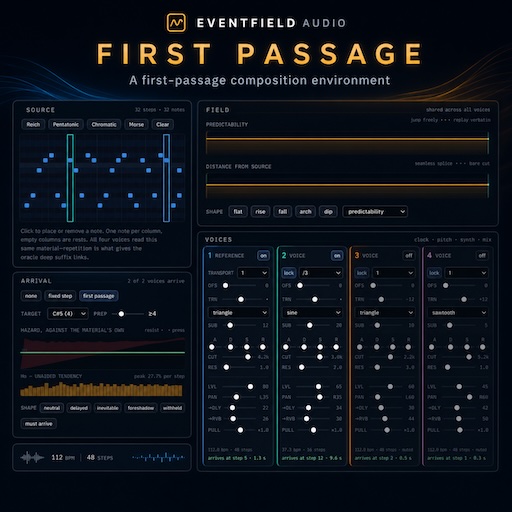
First Passage explores a different idea. You begin by drawing a short source sequence of notes and rests. Up to four voices then move through that same material, each with its own clock, offset, transposition, sound and relationship to the source.
The central concept comes from probability theory. A first-passage time is the first moment at which a changing process reaches a chosen state. In the instrument, that state becomes a target note. Rather than simply deciding whether the note is likely to appear, First Passage lets you shape when its first arrival becomes probable.
The target can be resisted, delayed, foreshadowed, withheld or made increasingly inevitable. Each voice may reach it by a different route and at a different moment. The destination is shared, but the journey is not.
A common probability field controls how the music changes over the course of the piece. Predictability determines whether the voices repeat established movement or jump more freely. Distance from the source controls how closely the generated material remains connected to the phrase you originally drew. These parameters can rise, fall, arch or dip through time, allowing the behaviour of the whole system to develop rather than remain static.
The four voices share the same musical environment but can interpret it very differently. One might remain close to the original sequence while another moves slowly through a transposed version. Each voice has independent timing, synthesis, filtering, panning and effects controls, so the same underlying material can become melody, counterpoint, pulse or texture.
First Passage is not intended to be an automatic song generator. The source material, target, probability field, timing and voice relationships are all compositional decisions. The instrument does not remove authorship. It moves authorship towards designing conditions, trajectories and moments of arrival.
What interests me most is whether this can give generative music a stronger sense of expectation and consequence. The precise route remains uncertain, but the listener can still feel that something is being approached, avoided or delayed.
The instrument runs entirely in the browser and can export its results as MIDI for further arrangement and development.
The route is uncertain. The arrival changes everything.